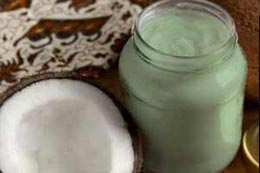
Infused Coconut oil
With its rich, tropical flavor and the delightful infusion of cannabis, this versatile oil elevates your cooking to new heights.
This cannabis infused coconut oil recipe is the foundation of all cannabis cooking, teaching you to infuse infused coconut oil with maximum potency and clean flavor. Cannabis butter and oil are the building blocks that you will use in countless edible recipes. Master this essential technique and you will have consistent, reliable infusions every time. Cannabis-infused coconut oil has the highest saturated fat content of any cooking oil, making it exceptionally efficient at binding THC.
- ½ cup of coconut oil
- 3.5 ground weed
- Decarb your weed - Learn how to do
- Add the weed to a canning jar with ½ cup of coconut oil.
- Seal the canning jar very tightly.
- Add the canning jar in boiling water using low-medium (240° F - 115° C) heat for over 2 hours.
- Put all the jar's content into a cheesecloth over a metal strainer.
- Gather the cheesecloth and squeeze all the remaining liquid out.
Dosing Tips for Your Infused Coconut oil
- Calculate potency by multiplying the THC percentage of your flower by the weight in milligrams, then multiply by your expected extraction efficiency (typically 60-80%).
- Label every batch with the date, strain, amount of flower used, and estimated mg per tablespoon for safe usage in recipes.
- Start with a known strain from a licensed source so the THC percentage on the label gives you a reliable starting point for calculations.
- Test a small amount of your finished infusion before cooking a whole recipe. Take half a teaspoon and wait 90 minutes to gauge potency.
- Pour into silicone ice cube molds for pre-measured tablespoon portions that are easy to pop out and use in recipes.
Common Mistakes to Avoid
- Skipping decarboxylation is the number one mistake. Raw cannabis contains THCA which is not psychoactive. Heat it at 240 F (115 C) for 40 minutes first.
- Cooking the infusion at too high a temperature. Keep it at a gentle simmer, 160-200 F (70-93 C), never a rolling boil.
- Not straining thoroughly. Squeeze the cheesecloth to get all the infused fat out, but do not force plant material through.
- Using too much flower relative to fat. A standard ratio is 1 cup of fat to 7-10 grams of decarbed flower. More flower does not always mean stronger.
How to Store Infused Coconut oil
- Cannabis butter keeps refrigerated in an airtight container for up to 2 weeks, or frozen for 6 months without significant potency loss.
- Cannabis oil (coconut, olive) keeps for 2-3 months in a cool, dark place. Refrigeration extends this further.
- Store in opaque containers or wrap in foil to protect from light, which degrades cannabinoids over time.
- Coconut oil is shelf-stable at room temperature for up to 3 months; refrigerate for longer storage up to 6 months.
Variations & Ideas
- Infuse coconut oil for a versatile, dairy-free option with excellent THC binding due to its high saturated fat content.
- Make cannabis ghee by clarifying the butter after infusion. It has a higher smoke point and longer shelf life than regular cannabis butter.
- Try infusing MCT oil for faster absorption and a neutral flavor that works in any recipe.
- Use refined coconut oil for a neutral taste in recipes where you do not want coconut flavor.
Frequently Asked Questions
Coconut oil and butter are the top choices because their high saturated fat content binds THC most effectively. Coconut oil edges out butter slightly in extraction efficiency and shelf life. Olive oil works too but has a lower saturated fat content.
Low and slow is the key. Simmer at 160-200 F (70-93 C) for 2-4 hours on the stovetop, or 4-6 hours in a slow cooker on the low setting. Longer infusion times at low temperatures extract more cannabinoids without degrading them.
Excessive green color and bitterness come from extracting chlorophyll and plant matter. Cook at lower temperatures, do not boil, and avoid grinding your flower too finely. A coarse grind with gentle heat produces a milder-tasting, golden butter.
Adding water to the pot during infusion helps regulate temperature and prevents burning. The water separates from the butter when cooled in the fridge and can be drained off. This technique produces cleaner-tasting butter with fewer impurities.
Yes, a slow cooker on the low setting is one of the best methods because it maintains a steady, low temperature for hours. Combine decarbed flower and oil, set to low, and let it go for 4-6 hours with occasional stirring. It is nearly foolproof.
Positive Effects
Negative Effects
You may or may not feel all the effects listed*